Fiestas del Pilar 2026: the complete guide to Zaragoza in October
From the 6.30am start of the Ofrenda de Flores to late-night bars in El Tubo, this insider Fiestas del Pilar 2026 guide explains what matters, what is free, and why Zaragoza in October is far better than many first-time visitors expect.
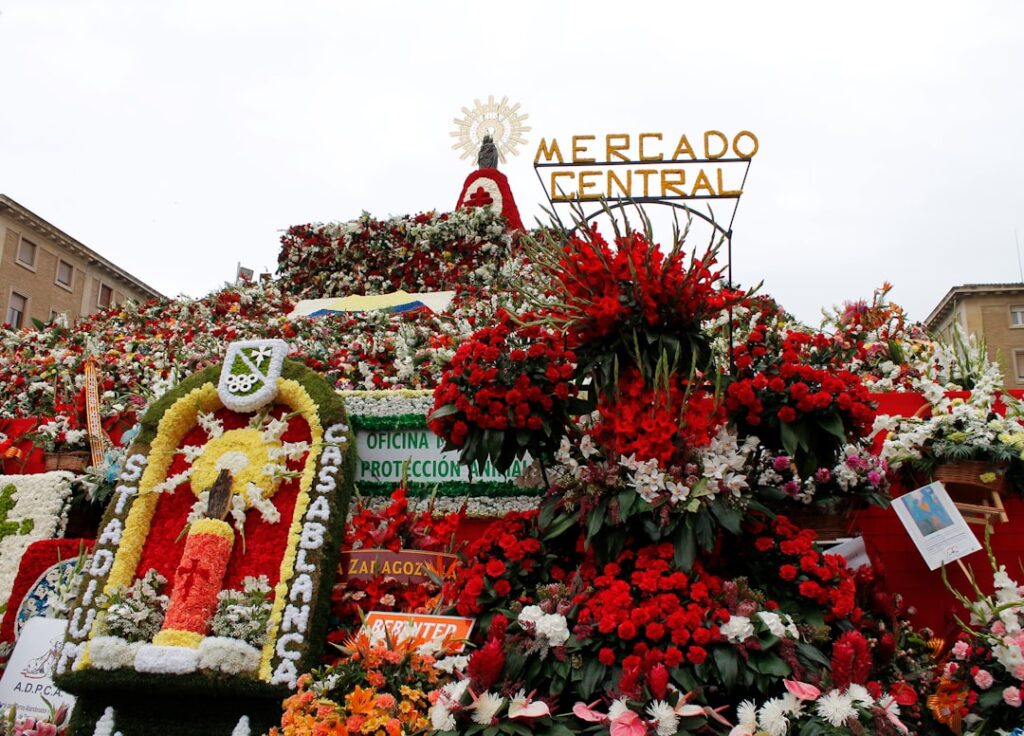
At about half past seven on the morning of 12 October, when most visiting journalists are still hunting for coffee, Zaragoza is already ankle-deep in carnations. The air around Plaza del Pilar smells faintly of damp stone, wax and crushed flowers, brass bands are warming up somewhere beyond La Seo, and families in regional dress are queueing with the kind of patience you only see at events that mean something. That, more than the fireworks or the late-night concerts, is the real beginning of the Pilar for me.
If you are planning a trip, this Fiestas del Pilar 2026 guide is the version I would give a friend: practical, honest and grounded in what the festival actually feels like on the ground. The dates for 2026 are 10 to 18 October, and yes, this Zaragoza October festival is absolutely worth travelling for, provided you come expecting a civic celebration with deep local roots rather than a glossy, stage-managed spectacle.
When should you actually come for the Pilar, and which dates matter most?
The official dates for the Fiestas del Pilar 2026 are 10 to 18 October, but not every day has the same atmosphere. If you only have a weekend, come as close as possible to 12 October, which is the feast day of the Virgen del Pilar and the emotional centre of the week. That is when the Ofrenda de Flores takes place, beginning at 6:30 in the morning and continuing until all registered groups have passed. It is one of those rare giant public events that still feels personal if you stand in the right place.
The trick is understanding the rhythm. Early festival days tend to feel expansive and sociable, with families out in the streets, fairground energy building and the city still functioning more or less normally. By the middle weekend and around the 12th, the centre becomes gloriously crowded. If you like atmosphere, that is the moment. If you dislike dense crowds, come on the 10th or 11th, or stay through to the 17th and 18th when the city exhales a little.
One very 2026-specific detail: the Ofrenda is changing in small but meaningful ways. Organisers will introduce random control checks to verify group sizes, there will be pass accreditations, and only groups linked to entities with a tax identification number can register, with a maximum of 200 people per group. That sounds bureaucratic, but it matters if you are joining through an association or trying to understand why the procession is more tightly managed than before. It is also a reminder that this is not a costume parade staged for tourists. It is a serious civic ritual that happens to be visually spectacular.
Another detail I like this year is the official poster. The 2026 image is La ciudad en ofrenda by Jesana Motilva Santaliestra, a title that gets something right about the whole week: the city itself feels as though it is making an offering, not just the people carrying flowers.
Is the Ofrenda de Flores worth the crowds, or should you skip it?
Do not skip it. Even if you hate queues, even if organised devotion is not normally your thing, even if you suspect it will be too pious or too provincial. The Ofrenda de Flores, first held in 1958, is the single event that explains Zaragoza to outsiders. Thousands of people pass through in regional costume, carrying flowers to create the vast floral mantle for the Virgin in Plaza del Pilar. It is moving because it is communal rather than theatrical. Grandparents, school groups, neighbourhood associations, sports clubs: everyone is there.
The best way to see it is not necessarily from the front. First-timers often aim straight for the busiest point beside the basilica, then spend the morning seeing very little except the backs of other spectators. I would instead arrive early and stand somewhere along the route where groups are still assembling and adjusting shawls, fixing waistcoats and negotiating children into line. You see the human side there. Later, drift back towards the square to watch the flowers being raised into place.
An unexpected detail that says a lot about the event: the most memorable moments are often sonic, not visual. The hollow thud of drums under the stone arcades, the rustle of flower wrapping, the applause when a particularly elegant group emerges into view. If you are there before 8am, the light on the river side of the square can be extraordinary too, particularly when the towers are still pale and the flower colours start to intensify.
If you do want to participate rather than watch, sort it out through a registered group well in advance because of the 2026 rules. If you only want to observe, wear comfortable shoes, bring coffee, and accept that this is a morning for standing still. Zaragoza rewards patience during the Pilar.
How much does the festival really cost, and what is free?
One of the best things about the Pilar is that the headline events are still largely public. Most of the major activities, including the Ofrenda de Flores and many open-air concerts, are free. That makes the city unusually generous during festival week: you can spend an entire day moving between music, processions and people-watching without paying for a ticket.
Where your budget changes is at night, especially if you drift into private venues or club-style events. For example, Sala Parros Zaragoza, in the Casco Antiguo, is selling advance festival tickets from 20 euros for certain events with open bar. That gives you a useful benchmark. Street life and civic programming can be almost free; private nightlife can add up quickly.
Food falls somewhere in the middle. The smartest way to eat during the Pilar is to abandon the idea of formal three-course dining every night and lean into tapas. In El Tubo, Bodegas Almau is one of those old-school stops where vermouth still feels like the right drink, not a retro affectation. A few minutes away, Taberna Doña Casta remains known for croquetas and an atmosphere that is loud in the best possible way. If you want a proper sit-down meal with history attached, Casa Lac, founded in 1825, is one of Zaragoza’s classics and still a convincing place to explore Aragonese cooking. For a quieter reset between festival assaults, Café Botánico is a good choice for breakfast or merienda.
My honest advice for British visitors is to budget more for food and late drinks than for cultural access. The festival itself is not what empties your wallet. Hunger at 11pm in a packed old town is the dangerous bit.
Can you do the Pilar on foot, or do you need transport?
You can and should do most of it on foot. The central festival geography is refreshingly compact. Plaza del Pilar sits in the heart of Zaragoza and is reachable from almost anywhere in the centre in under 10 minutes on foot. Once you understand that, the city becomes much easier to navigate than many first-time visitors expect.
This matters because taxis and buses can become less appealing than your own legs during the busiest festival windows. Streets close, crowds bunch up and what looks quick on a map can be slower in practice. If you are staying centrally, you can step out for an hour, catch a concert, walk back for a rest, then head out again without logistical drama.
A useful concrete example: Sala Parros Zaragoza is around five minutes on foot from Plaza del Pilar, in the Casco Antiguo. That means you can move from the ceremonial centre of the city to private nightlife almost immediately, which partly explains why festival nights gather so much momentum. You can go from a family-friendly evening stroll in the square to a loud dancefloor without ever considering a car.
The only caveat is footwear. The old town is handsome but not built for fragile shoes, and Pilar days are longer than they look on an itinerary. I have seen far too many visitors arrive in elegant ankle boots and spend the second day moving with the expression of medieval martyrs. Trainers are not glamorous, but neither is limping past the basilica.
Where should you eat between processions, and which places are more than tourist filler?
During the Pilar, hunger arrives suddenly. You spend hours standing, walking and being distracted by noise, and then at some odd time between lunch and dinner you realise you need feeding immediately. This is when knowing a few reliable names matters.
El Tubo is the obvious answer, but not all obvious answers are bad. The area works because it is dense, lively and forgiving of indecision. Bodegas Almau, on Calle Estébanes, is one of those bars that feels older than memory, with shelves and bottles doing half the decorating for them. It is a good place to begin with something simple and salty alongside vermouth. Taberna Doña Casta is famous for croquetas, and yes, it gets busy, but there is a reason people keep returning.
For a meal with more ceremony, Casa Lac is worth the money and the planning. Founded in 1825, it has genuine historic weight rather than fake old-world charm, and if you are trying to persuade a sceptical travelling companion that Zaragoza can hold its own gastronomically, this is one of the places to make that case.
Then there is the question of timing. The underused strategy during the Pilar is to eat either slightly earlier or slightly later than instinct suggests. If you attempt lunch at the exact moment everyone else emerges from a morning event, you will queue. If instead you stop for coffee and something light at Café Botánico, let the surge pass, and then sit down afterwards, the city becomes far more pleasurable.
An unexpected local truth: some of the nicest festival food moments are not dinners at all, but those in-between pauses when you slip away from the crowds for coffee, cake or a simple plate in a side street and can hear the brass bands at a distance. Zaragoza is unusually good at that sense of being near the party without being swallowed by it.
Why do the Gigantes y Cabezudos still matter, and are they just for children?
They are not just for children, though children understandably adore them. The Gigantes y Cabezudos are among the festival traditions that visitors often underestimate because they sound quaint on paper. In practice they are rowdy, theatrical and woven into local memory in a way that the bigger ticketed events often are not. The tradition dates back to the 19th century, and the figures represent a mix of historical and popular characters linked to Zaragoza.
If you have never seen them before, expect less stately folklore and more controlled chaos. Children squeal, parents half-protect and half-encourage them, and the oversized heads have exactly the kind of comic menace that makes old festival traditions survive. What I love is that they still belong to the street. You do not consume them from a distance; you bump into them, hear them before you see them and suddenly find yourself swept into an entirely local excitement.
For adults, the appeal is partly historical. The Pilar has not survived by becoming a museum piece. These traditions continue because they are still used, still argued over, still loved. In a Europe full of festivals that have become content for visitors, Zaragoza retains moments that feel stubbornly unperformed.
Is Zaragoza actually worth visiting in October if you are coming from Britain?
Yes, with one honest caveat: it depends what kind of trip you want. If you want polished, internationally famous landmarks every ten steps and a city that rearranges itself for tourists, Zaragoza may not flatter you instantly. It is not Barcelona, and that is exactly why many of us end up loving it more. The Pilar reveals the city at full volume, and that means you meet Zaragoza as locals live it: sociable, slightly chaotic, proud, funny and deeply attached to its own traditions.
For British readers, I think the appeal is threefold. First, the weather in October is often far kinder than the UK’s without the draining heat of high summer. Second, the city centre is walkable in a way that makes a short break easy rather than exhausting. Third, the festival itself is big enough to feel thrilling but rooted enough to feel meaningful. You are not just attending another urban event series. You are stepping into a civic ritual.
There are also smaller pleasures that stick with you: late sunlight on the stone of Plaza del Pilar, children in traditional dress eating crisps with complete seriousness, and the strange brilliance of hearing church bells and fairground noise at the same time. Even the pre-festival fringe can be worth timing around. On 8 October, for instance, the fifth edition of Casa Vero Zaragoza is due to take place at Restaurante Aura, combining live music with wine tasting. It is the sort of side event that reminds you how much of the Pilar week extends beyond the square itself.
If you are still unsure, I would put it like this. Zaragoza is worth visiting in October not because every minute is picturesque, but because the city feels fully inhabited. You leave with a sense of having been somewhere real.
Where should you stay if you want to be central without making life difficult?
Stay as close to the old town as your budget allows. During the Pilar, location matters more than hotel extras. Being able to walk back to your room between events, drop layers, rest for an hour and head out again is worth far more than a generic chain breakfast on the edge of town.
If you want a practical central option, ZaragozaHome has two apartments at Puerta Cinegia, right between El Tubo and Plaza España. That puts you within easy walking distance of Plaza del Pilar while keeping restaurants and late-night bars on your doorstep. Private parking is included, which is more useful than it sounds during festival week, and rates start from 85 euros a night. It also carries a 9.8 rating on Booking.com, which in this city usually signals that the basics have been done very well indeed.
FAQ
When are the Fiestas del Pilar 2026?
They run from 10 to 18 October 2026 in Zaragoza, with 12 October as the key day for the Ofrenda de Flores.
Do you need tickets for the main Pilar events?
Usually no. Most flagship events, including the Ofrenda de Flores and many outdoor concerts, are free. Some private venues and parties do charge, with examples such as advance entry from 20 euros at Sala Parros Zaragoza for certain festival nights.
What time does the Ofrenda de Flores start in 2026?
It starts at 6:30 on 12 October 2026 and continues until all participating groups have finished.
Stay in the middle of the Pilar, not on the edge of it
If you want to do the festival properly, base yourself somewhere central enough to walk everywhere. ZaragozaHome’s Puerta Cinegia apartments sit between El Tubo and Plaza España, include private parking, and make it easy to dip in and out of the crowds without losing half your day in transport.
Looking for accommodation in central Zaragoza? Our ZaragozaHome apartments are steps from the Pilar, La Seo and El Tubo. Private parking included and rated 9.8 on Booking.com.