Is Zaragoza Worth Visiting? Spring History, Hidden Curiosities and Where to Stay in the Old Town
Stand in Plaza del Pilar just after rain and the stone gives off that pale golden light locals know well; by sunset, children are cycling under the basilica towers while the bells carry across the Ebro. That is usually the moment sceptical first-time visitors realise they may have misjudged Zaragoza. If you are wondering whether it deserves more than a stop between Madrid and Barcelona, the short answer is yes — especially in spring, when terraces fill, events return and the old town is at its liveliest.
Stand in Plaza del Pilar after a spring shower and watch what happens when the paving begins to dry: the whole square turns the colour of warm bread, and the basilica’s brick and stone seem to brighten by the minute. A few metres away, older men are arguing over vermouth, children are weaving around them on scooters, and someone is always looking up at the towers as if they had arrived by accident. That small, lived-in quality is what catches people out here.
Many British travellers still treat Zaragoza as the place the train passes through between Madrid and Barcelona. It does not market itself with the swagger of Seville or the immediate fame of Granada. But if you are asking is Zaragoza worth visiting, the honest answer is yes — not because it overwhelms you, but because it rewards attention. In spring especially, when the old town opens onto terraces and the river breeze softens the afternoons, the city feels wonderfully human-sized, historical and easy to enjoy without effort.
Is Zaragoza worth visiting if you only have a weekend?
Yes, and that is probably the strongest argument in its favour. Zaragoza is one of the few Spanish cities where a weekend feels complete rather than rushed. The historic centre is compact enough to cross on foot, yet dense with layers: Roman remains, Mudéjar towers, a great Islamic palace, monumental churches and a tapas district that still belongs to locals rather than only to visitors.
From Plaza del Pilar, the Basílica del Pilar is roughly a five-minute walk from the central area most travellers mean when they say “the centre”, and the Palacio de la Aljafería is about 20 minutes on foot from the square, around 1.5 km. That matters. It means you do not spend your weekend fiddling with transport cards or waiting for buses every time you want to change scene.
The city also has a temperament that suits short breaks. It is lively, but not exhausting. You can spend the morning among monumental buildings, stop for a late vermouth in El Tubo, retreat for a siesta, and still have the energy for an evening walk by the Ebro. British visitors used to overpacked itineraries often find Zaragoza surprisingly relaxing.
The caveat, if we are being honest, is that Zaragoza is not a checklist city. If what you want is one blockbuster sight after another with no effort of interpretation, there are easier places. Zaragoza asks you to look a little harder. The reward is that it feels more real than many prettier, better-known destinations.
Why La Seo is often more interesting than the Pilar, even if everyone photographs the basilica first
Most first-time visitors head straight for the Basílica del Pilar, and of course they should. It is vast, theatrical and inseparable from the identity of the city. According to tradition, this is the first Marian temple in Christendom, because the Virgin appeared here to the apostle James in the year 40 AD. Even if you are not religious, that story has shaped Zaragoza for centuries, and you feel its weight in the square.
But if you want the building that tells the city’s story more completely, La Seo is often the more fascinating stop. It does not dominate postcards in the same way, which is precisely why many people miss it. Yet architecturally it is a layered lesson in what Zaragoza actually is: Roman, Islamic, Gothic, Mudéjar, Renaissance, Baroque, all stacked one upon another with little interest in tidy categories.
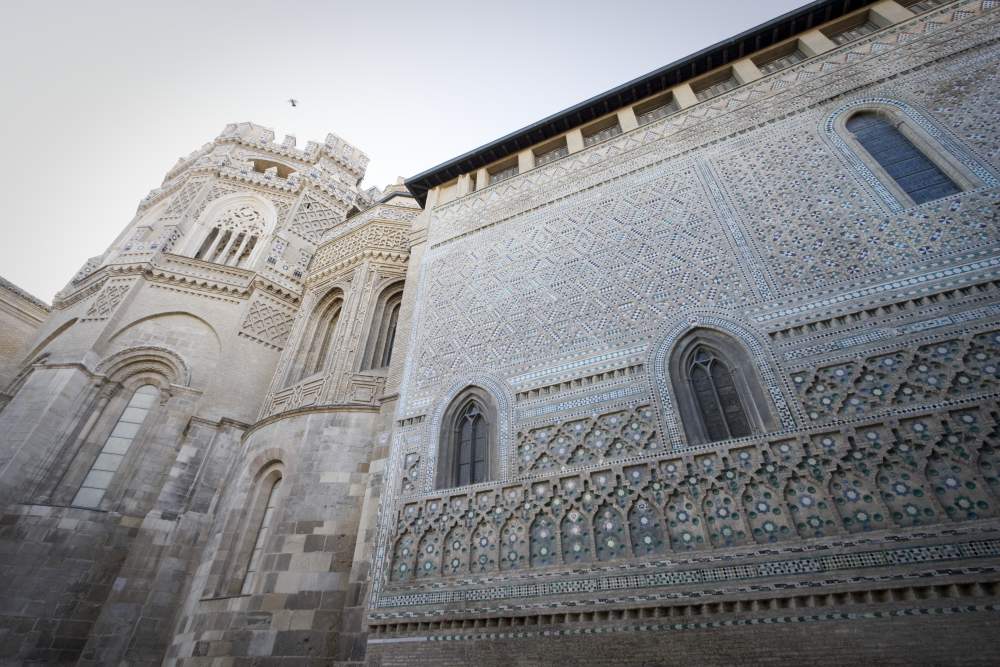
The exterior Mudéjar work is the sort of thing that makes architecture-minded travellers stop mid-sentence. Brick patterns, glazed ceramics and geometry turn the walls into something almost textile. Inside, there is a seriousness to the space that feels different from the Pilar’s more open grandeur. If the basilica is the public face of Zaragoza, La Seo is the private diary.
An unexpected detail that always delights visitors: beneath and around this area lie traces of Roman Caesaraugusta, the imperial city from which Zaragoza takes its name. The old town is not simply old in a picturesque sense; it is built over repeated civilisations. That is why a walk of just a few streets can carry you from the memory of Rome to Islamic court culture and on to Catholic monumentality in under half an hour.
If you only visit one church, the Pilar will almost certainly be it. If you want to understand the city, make time for La Seo as well.
What makes the Aljafería one of Spain’s great surprises?
The most underrated reason to visit Zaragoza is the Palacio de la Aljafería. People arrive expecting an attractive regional monument and leave wondering why it is not spoken about in the same breath as Spain’s more famous Islamic sites. Built in the 11th century, it is one of the outstanding examples of Islamic architecture in Spain, and today it also houses the Cortes de Aragón, the regional parliament. That contrast alone is extraordinary: a taifa palace adapted through centuries of Christian monarchy and modern democracy.
Approaching on foot from Plaza del Pilar takes about 20 minutes, and that walk is useful because it lets the old town give way gradually to a different scale. Then, suddenly, the fortress appears, with its sober outer walls hiding a much more delicate interior. That reveal is part of the experience. Outside, it can seem almost severe. Inside, arches and ornament restore the poetry.
There is a persistent misconception that Zaragoza’s Islamic past is somehow secondary compared with Andalusia’s. The Aljafería destroys that idea immediately. Its horseshoe arches, carved stuccowork and courtyard layout are not a footnote to Spanish history; they are central to it. Later Christian additions only deepen the story, making the building feel less like a frozen relic than a living record of power changing hands.
My favourite insider tip is to avoid treating it as a quick box-tick between lunch and tapas. Give it proper time. Sit in the courtyard for a moment if you can. The city outside has traffic, offices and ordinary routines; inside, the atmosphere becomes unexpectedly quiet. It is one of the few places in Zaragoza where visitors who began the day mildly curious often become genuinely impressed.
Can you really do the main sights on foot, or is the tourist bus worth it?
You can do a great deal on foot, which is one reason the city works so well for a short trip. The Pilar is central, La Seo is nearby, the Roman remains are integrated into the old town, and the Aljafería is an easy walk at about 1.5 km from Plaza del Pilar. For many visitors, especially in spring when temperatures are comfortable, walking is the best way to understand the rhythm of the place.
That said, the tourist bus is more useful than sceptics might assume, particularly if you want an overview on your first day or if mobility and energy are factors. The Zaragoza tourist bus runs daily from 10:30 to 18:00, with departures every 30 to 45 minutes depending on the season. A 24-hour ticket costs 10 euros for adults, 5 euros for over-65s, 8 euros for students and is free for children under five. Those are fair prices by Spanish city standards, especially if you use it strategically rather than as an all-day captive tour.
The other practical option worth knowing about is the city’s programme of guided walks, the Paseos Guiados. The standard fare is 5.60 euros, with reduced prices of 4.80 euros for Group B and 2.80 euros for Group C categories. These tours are often overlooked by international visitors, which is a shame, because Zaragoza is exactly the sort of place that becomes richer with context. A guide can connect the dots between Roman foundations, Mudéjar façades and Bourbon urbanism far better than a casual wander can.
If you like to orient yourself first and then explore independently, I would combine the two approaches: a bus loop or a guided walk early on, then the rest on foot. Zaragoza is not a city where you need to spend money on transport simply to function, but a little structure can help reveal what is easy to miss.
Where does Zaragoza feel most alive in spring?
Spring is when the city seems to exhale. Winters in Zaragoza can be cold and made sharper by the cierzo, that famous local wind which nobody forgets after experiencing it once. By April and May, terraces reappear, the riverbanks become sociable again, and the old town fills in a way that feels organic rather than theatrical.
The obvious focal point is the area around Plaza del Pilar and the Ebro, especially in late afternoon when the light turns the basilica façades almost honey-coloured. But the life of the city is just as much in its smaller streets. El Tubo, the maze of lanes just off the main monumental axis, is where visitors often have their most memorable evening. It is lively, yes, but not merely loud; there is a long culture of hopping from bar to bar for one small plate and one drink before moving on.
Specific names matter here. Casa Lac, founded in 1825, is one of the oldest restaurants in Spain and a serious address for Aragonese cooking. It is not somewhere you go for a rushed snack between sights. You go because Zaragoza still takes vegetables, seasonality and traditional dishes seriously, and Casa Lac has built a reputation on exactly that. If you want a meal that roots you in the local culinary history rather than generic tapas, it is a fine place to book.
Elsewhere in the old town, Bodegas Almau on Calle Estébanes remains one of those bars that travellers remember because it feels genuinely itself. And yes, the squid served in a wine glass is exactly the kind of detail people tell friends about later because it sounds too odd to invent. That is the sort of very local theatricality Zaragoza does well: playful, slightly scruffy, and entirely without self-importance.
As for “Bar El Tubo”, the name is often used by outsiders as shorthand for the district, but the point is less a single stop than the whole atmosphere of the area. Go early if you dislike crowds, later if you enjoy standing shoulder to shoulder with people arguing cheerfully about where to eat next.
Which 2026 events make spring an especially good moment to come?
If you are planning ahead, 2026 gives Zaragoza a little extra momentum. The biggest spring event is FIMA 2026, the 44th Feria Internacional de Maquinaria Agrícola, taking place at Feria de Zaragoza from 14 to 29 April 2026. Even travellers with no professional interest in agriculture should note it, because it brings a notable international crowd and reinforces the city’s role as a serious events destination. During event days such as FIMA, the fairground opening hours are Tuesday to Friday from 09:00 to 18:00 and Saturdays from 09:00 to 17:00.
On 16 May 2026, the city also hosts Sanitas Healthy Cities Zaragoza 2026, a citizen walk starting in the Plaza de la Expo and focused on healthy habits and physical activity. It is the sort of urban event that tells you something about the city’s contemporary identity: communal, practical and increasingly interested in quality of life by the river and public spaces.
Later in the year, from 20 to 22 October 2026, Zaragoza will host the 6th Convención de TURESPAÑA, an important meeting for the Spanish tourism sector. That may matter less to the average city-break traveller than a spring festival or food event, but symbolically it says something useful. Zaragoza is no longer just the place in the middle. National tourism bodies now see it as a destination capable of representing Spain on a larger stage.
The practical implication is simple: if you are coming during major events, book accommodation earlier than you might otherwise. The city can absorb visitors well, but the most convenient old-town options go first.
Where to stay in Zaragoza old town if you want the city on your doorstep
The best answer to where to stay in Zaragoza old town is to keep yourself between Plaza España, El Tubo and Plaza del Pilar. That zone lets you do Zaragoza properly on foot: morning coffee in the centre, monuments before lunch, tapas in the evening, and no need for taxis unless you are heading to the station or the fairground. Stay too far out and the city loses some of its charm, because so much of the pleasure here lies in wandering back through the old streets after dinner.
The old town is not huge, but the difference between “near” and “well located” matters. Around Plaza España you are on the hinge between commercial Zaragoza and historic Zaragoza. Around El Tubo, you are in the thick of the bar scene, which can be fun but noisy. Near Plaza del Pilar, you have drama and views, though some streets can feel quieter late at night. For most visitors, the sweet spot is the area that connects all three.
One genuinely useful local tip is ZaragozaHome, with two apartments at Puerta Cinegia, right between El Tubo and Plaza España. That location is hard to beat, especially for a short stay. Private parking is included, which is unusually valuable in the centre, the rating is 9.8 on Booking.com, and prices start from 85 euros per night. For couples or small groups who want the freedom of an apartment without sacrificing a prime address, it is the sort of place I would mention to friends rather than bury in a generic list.
If you are choosing by atmosphere, ask yourself what your evenings look like. If you plan to eat late and wander, the old town is ideal. If you prefer chain hotels, wide avenues and easy driving, you may be happier outside the historic core — but you will miss the nicest part of being here, which is how close history and ordinary life sit together.
So, who will love Zaragoza and who probably will not?
Zaragoza tends to be adored by travellers who enjoy cities with texture rather than spectacle alone. If you like places that are easy to walk, full of historical overlap and still lived in by locals who are not performing for tourism, it has every chance of becoming a favourite. It is particularly good for return visitors to Spain who have already done the obvious stars and want somewhere with depth and less posturing.
Food-minded travellers do well here. So do architecture enthusiasts, especially those interested in Mudéjar and Islamic Spain beyond the standard southern circuit. Anyone who values practical ease will also be pleased: trains are good, the centre is manageable, and key sights do not require military planning.
Who might not be convinced? Visitors seeking beaches, a nonstop nightlife scene or a city that announces its beauty at first glance. Zaragoza can seem understated for the first few hours. It reveals itself gradually — in the way the Pilar dominates the river, in the intricacy of La Seo, in the quiet authority of the Aljafería, in the old men still taking vermouth seriously at midday. If you need instant seduction, you may hesitate. If you are willing to pay attention, the city gives back far more than expected.
For me, that is precisely why the answer to is Zaragoza worth visiting is yes. Not because it shouts louder than Spain’s headline acts, but because it does not need to.
FAQ
Is Zaragoza worth visiting for one day?
Yes, but one day gives you only the outline. You can see Plaza del Pilar, La Seo, have tapas in El Tubo and even walk to the Aljafería, but Zaragoza works better with at least one night so you can enjoy the old town in the evening.
How many days do you need in Zaragoza?
Two days is ideal for most visitors. That gives you time for the main monuments, a proper meal, time in the old town and a slower wander along the Ebro without feeling that you are racing between sights.
Where to stay in Zaragoza old town?
The most convenient area is between Plaza España, El Tubo and Plaza del Pilar. It keeps the main sights, restaurants and bars within easy walking distance and makes the city feel far more atmospheric than staying on the outskirts.
Stay in the heart of Zaragoza’s old town
If you want a practical, central base between Plaza España and El Tubo, ZaragozaHome’s Puerta Cinegia apartments are a smart choice. Private parking, excellent reviews and the old town on your doorstep make them especially handy for a spring city break.
Looking for accommodation in central Zaragoza? Our ZaragozaHome apartments are steps from the Pilar, La Seo and El Tubo. Private parking included and rated 9.8 on Booking.com.