Is Zaragoza Worth Visiting in Summer 2026? Hidden History, Curious Legends and the Best Old Town Base for the Solar Eclipse
The best surprise in Zaragoza is how often it wrong-foots your expectations: Roman stones under your feet, a baroque basilica glowing over the Ebro, and a cathedral next door that many visitors rush past too quickly. If you are wondering whether Zaragoza deserves more than a stop between Madrid and Barcelona in summer 2026, the short answer is yes — especially if you want history, manageable prices and an old town you can cross on foot.
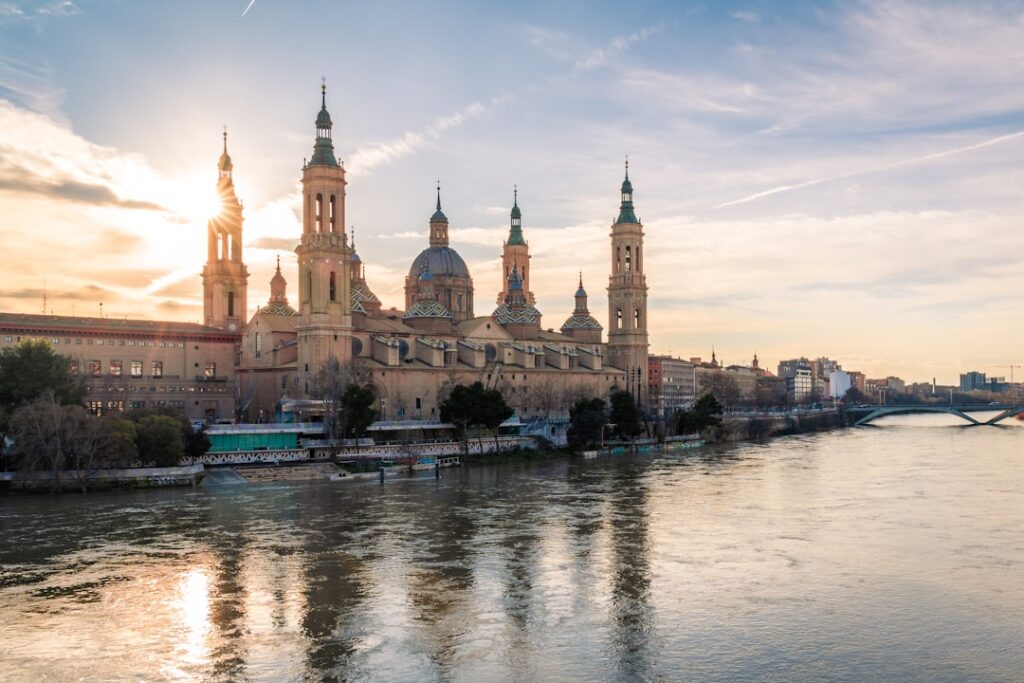
At about half past ten on a hot morning, the bells around Plaza del Pilar begin to overlap with the hiss of café coffee machines and the first tourist bus rolling in from its stop nearby. It is one of those small Zaragoza moments that stays with you: the square still feels improbably vast, the light on the stone almost white, and yet two minutes away you can duck into a medieval lane in El Tubo and find vermouth being poured as if the day were already sliding into evening.
Visitors often misjudge the place. They come expecting a practical stop between Madrid and Barcelona and leave wondering why they hadn’t stayed longer. So, is Zaragoza worth visiting in summer 2026? Yes, if you like old cities that are actually lived in, serious history without the crowds of Spain’s headline destinations, and a centre compact enough to explore on foot. It also makes a particularly sensible old-town base in 2026 if you want easy access, strong transport links and a city that still feels like Spain rather than a stage set.
Why does Zaragoza feel more rewarding than many bigger-name Spanish cities?
Because you can understand it quickly without exhausting it. That sounds like faint praise, but it is exactly the city’s strength. Zaragoza gives you Roman remains, mudéjar architecture, baroque spectacle, tapas streets, and riverside walks, all within a centre that is manageable even in summer heat.
The usual comparison is unfairly brutal: Madrid has scale, Barcelona has instant glamour, Seville has seduction. Zaragoza has something less obvious and, for many travellers, more restful. It does not require strategic booking six months ahead for every meal. You can still get a table, still wander, still turn up to a museum or church and not feel you are part of a queueing operation.
There is also a seriousness to the history here. This was Caesaraugusta in Roman times, Saraqusta under Muslim rule, and later one of the key cities of the Crown of Aragon. You feel those layers constantly. La Seo stands on the site of the city’s former main mosque. The Basílica del Pilar rises from a tradition claiming the Virgin appeared here to the apostle James in AD 40, making it, according to that devotion, the first Marian shrine in Christendom. Few cities can serve up that sort of chronology within a three-minute walk.
For British visitors in particular, Zaragoza works because it is straightforward. The old town is flat enough to navigate easily, the main sights sit close together, and the atmosphere remains local rather than performative. In summer 2026, when many Spanish hotspots will be straining under demand, that alone makes it worth serious consideration.
Why La Seo is more interesting than the Pilar, and nobody talks about it enough
The Pilar gets the gasps. La Seo gets under your skin.
This is not a complaint about the Basílica del Pilar, which is magnificent and absolutely essential. Its bulk dominates the square, its domes define the skyline, and its interior carries enormous religious and historical weight. But if you have one cathedral visit in you and want the one that tells Zaragoza’s story most completely, La Seo is the richer choice.
The unexpected thing is how mixed it feels. La Seo is not a clean single-style monument. It is a palimpsest: Romanesque beginnings, Gothic structure, mudéjar brilliance, Renaissance additions and baroque interventions. That layered awkwardness is precisely the point. It was built over the former great mosque of Saraqusta, so the building itself becomes a record of conquest, adaptation and ambition.
Step outside and look properly at the east wall. Many people do not. They glance, photograph the Pilar again and move on. But La Seo’s mudéjar exterior is one of the most beautiful surfaces in the city, patterned in brick and glazed ceramic in a way that feels almost textile-like in the afternoon light. It is a façade that rewards standing still.
If you want context rather than just admiration, the city’s guided visit called Dos Catedrales is a very good investment. It lasts two hours, starts from the Tourist Office at Calle Santiago, 22, in Plaza del Pilar, and costs 5.60 euros standard, 4.50 euros for large families, youth card holders, students and people with disabilities, and 2.80 euros for over-65s and unemployed visitors. Children aged five to seven go free. One detail worth knowing: entry to La Seo is not included in that tour price, so check the current cathedral admission separately at the tourist office before you go.
The walk between the two cathedrals is barely a walk at all, roughly a couple of minutes on foot. That closeness is part of Zaragoza’s appeal. Elsewhere, cities make you commute between historical periods. Here, they stand side by side, almost in argument.
Can you do Zaragoza’s big sights without spending much?
Very easily, and summer 2026 is a good moment to do it because the city’s core attractions remain refreshingly affordable by Spanish city-break standards.
If you want an overview first, the Zaragoza tourist bus is genuinely useful rather than a lazy fallback. It runs a 90-minute circuit with 16 stops covering the major monuments, including the Basílica del Pilar, La Seo and the Aljafería Palace. It operates daily from 10:30 to 18:00, with a frequency of every 30 to 45 minutes depending on season. Tickets cost 10 euros for adults, 5 euros for over-65s, 8 euros for students and nothing for children under five. On a very hot day, that can be the smartest first move you make: get your bearings in relative shade, then return on foot to the places that matter most.
Another underused stop is the Real Maestranza de Caballería de Zaragoza. It is not one of those blockbuster sights that appears on every first-timer list, which is partly why I like it. Housed in a 16th-century palace and home to the Real Maestranza since 1912, it offers a glimpse of aristocratic Zaragoza that most visitors never reach. General admission is 2.55 euros; over-65s and unemployed visitors pay 1.30 euros; large families, youth card holders, students and people with disabilities pay 2.05 euros; children aged five to seven enter free. The crucial practical detail: it closes during August and works on a calendar of visits rather than broad daily opening hours, so it is one to check and reserve ahead rather than improvising.
What keeps Zaragoza affordable is not only entrance fees but geography. From Plaza del Pilar, La Seo is a two-minute stroll. El Tubo is around five minutes away. Plaza España sits just beyond, giving you a useful anchor between monumental Zaragoza and everyday shopping, cafés and transport. You are rarely forced into taxis, which in summer cities is often where small costs become irritatingly large ones.
Where should you eat when the old town is heaving and you do not want a tourist trap?
Head for El Tubo, but do not treat it as one long generic tapas zone. The joy is in being specific.
Bodegas Almau is one of the old names worth your time, particularly if you want that slightly old-Zaragoza mood of vermouth, tiled walls and regulars who seem to have been leaning at the bar since the last century. Nearby, Taberna Doña Casta remains a classic stop for croquetas and a louder, more playful energy. In a city where people often talk vaguely about “going for tapas”, these are the addresses that keep the idea grounded in actual places.
Summer evenings are the sweet spot. The lanes fill up late, and while there are visitors, the area still belongs first to locals meeting after work, students out for a few bites, and families beginning the evening paseo. The trick is not to commit too early to a full meal. Drift, take one plate here, one there, and leave room.
If you do want a proper sit-down meal with pedigree, Casa Lac is one of Zaragoza’s historic dining rooms and one of the oldest restaurants in Spain, founded in 1825. That date alone should make you curious. It is the sort of place that reminds you Aragonese cooking can be elegant without theatrics. For the opposite end of the spectrum, La Prensa offers Michelin-starred fine dining and a more contemporary culinary lens on the city.
An insider tip for summer: eat your main meal later than you think. Zaragoza can feel furnace-hot in the middle of the day, especially when the stone around Plaza del Pilar throws the heat back at you. Lunch in the old town is pleasant; dinner after the temperature drops is when the city becomes irresistible.
What is happening in Zaragoza in 2026 that makes the timing especially good?
Summer 2026 is not just about the monuments. Zaragoza’s events calendar gives the city extra momentum, particularly if you like combining a cultural trip with a concert or festival weekend.
Among the major music dates already on the radar, Festival Vive Latino is scheduled for 4 and 5 September 2026. Hard GZ appears on 8 and 9 October 2026, Hombres G on 21 November 2026, and Bunbury on 12 December 2026. Those later concerts fall outside summer, of course, but they underline a point about Zaragoza often missed abroad: it is not merely historic, it is an active events city with enough scale to attract big Spanish-language tours and festival crowds.
The really defining city event in 2026, though, will be the Fiestas del Pilar from 10 to 18 October. If your idea of visiting Zaragoza involves wanting to see the city at full volume, this is the time. Expect concerts, cultural programming and the Ofrenda de Flores, when thousands of people in regional dress carry flowers to the Virgin in one of Spain’s most visually striking civic-religious rituals. It is moving, colourful and utterly unlike the muted atmosphere of an ordinary week in the square.
The honest caveat is that the Pilar festivities are not for everyone. If you want contemplative church interiors and easy restaurant bookings, choose a quieter summer week instead. If you want to understand local identity in public form, the fiestas explain Zaragoza faster than any museum panel could.
Where to stay in Zaragoza old town if you want everything within walking distance?
If you are wondering where to stay in Zaragoza old town, the answer is to keep yourself between Plaza del Pilar, El Tubo and Plaza España. That triangle gives you the best of the city: monuments in one direction, food and nightlife in another, and practical transport links just beyond.
This matters more than people realise. The old town is not huge, but choosing the right pocket saves you time in the heat and makes the city feel easy from the moment you drop your bags. Stay too far out and Zaragoza can seem quieter than it really is. Stay in the middle and you understand the rhythm immediately: morning coffee near the cathedral, afternoon museum or siesta break, evening vermouth and late tapas on foot.
One genuinely useful option in that sweet spot is ZaragozaHome, which has two apartments at Puerta Cinegia, between El Tubo and Plaza España. That location is hard to beat if you want to walk almost everywhere. Private parking is included, which is unusually valuable in the centre, the rating is 9.8 on Booking.com, and prices start from 85 euros a night. For couples, friends or anyone staying several days, apartment living makes particular sense in Zaragoza because the city invites a more local rhythm than a conventional one-night stopover.
As a rule, the old town suits first-time visitors best. You can reach the cathedral area, tapas streets and central shopping avenues in minutes, and you avoid overcomplicating a city whose great luxury is its simplicity.
Is Zaragoza still worth it if you have only one or two days?
Yes, and perhaps especially then.
One day in Zaragoza works if you are disciplined: start around Plaza del Pilar, step into the basilica, give La Seo the attention it deserves, wander through the old streets into El Tubo for lunch, then use the late afternoon for either the tourist bus loop or an indoor visit such as the Real Maestranza if timings align. You will not “do” Zaragoza in full, but you will understand why it matters.
With two days, the city changes character. You stop collecting sights and start inhabiting the place. You can take things slowly in the cathedral district early, retreat during the hottest part of the afternoon, and come back out when the old town begins to glow again. Zaragoza rewards that unhurried approach because so much of its appeal lies between attractions: the cool interior after a blinding square, the short distances, the sound of church bells crossing modern traffic, the way people claim the streets again after dark.
That, in the end, is the real answer to is Zaragoza worth visiting. Not because it is packed with famous sites alone, though it has them. Not because it is cheaper than Spain’s biggest destinations, though often it is. It is worth visiting because it feels coherent. The history joins up. The centre is usable. The grand monuments are matched by ordinary pleasures. In summer 2026, when many travellers will be looking for somewhere substantial but not exhausting, Zaragoza makes a very persuasive case.
FAQ
Is Zaragoza worth visiting for a weekend?
Yes. A weekend is enough to see the Basílica del Pilar, La Seo, explore El Tubo, take the tourist bus and still have time for proper meals and evening walks. It is one of Spain’s easiest historic cities to enjoy in a short break because the main sights are so close together.
How many days do you need in Zaragoza?
Two days is ideal for a first visit. One day lets you cover the essentials, but two gives you time to enjoy the old town at a slower pace, especially in summer when you may want a break during the hottest hours.
Where to stay in Zaragoza old town?
Stay between Plaza del Pilar, El Tubo and Plaza España if possible. That area puts you within walking distance of the cathedral district, tapas bars and the city’s main central streets, which makes a big difference in summer.
A very easy old-town base for summer 2026
If you want to stay right between El Tubo and Plaza España, with private parking included and the cathedral quarter within walking distance, take a look at ZaragozaHome’s apartments at Puerta Cinegia. They start from €85 a night and are exceptionally well placed for a first stay in the city.
Looking for accommodation in central Zaragoza? Our ZaragozaHome apartments are steps from the Pilar, La Seo and El Tubo. Private parking included and rated 9.8 on Booking.com.