Aljaferia Palace Zaragoza in Summer 2026: History, Hidden Curiosities and a Smart Zaragoza City Break Base
The Aljafería is not just Zaragoza’s great monument but one of Spain’s most layered palaces: Islamic pleasure palace, royal residence, prison, barracks and now the seat of Aragón’s parliament. Here’s how to visit it well in summer 2026, what most people miss and why it makes a surprisingly practical base for a Zaragoza city break.
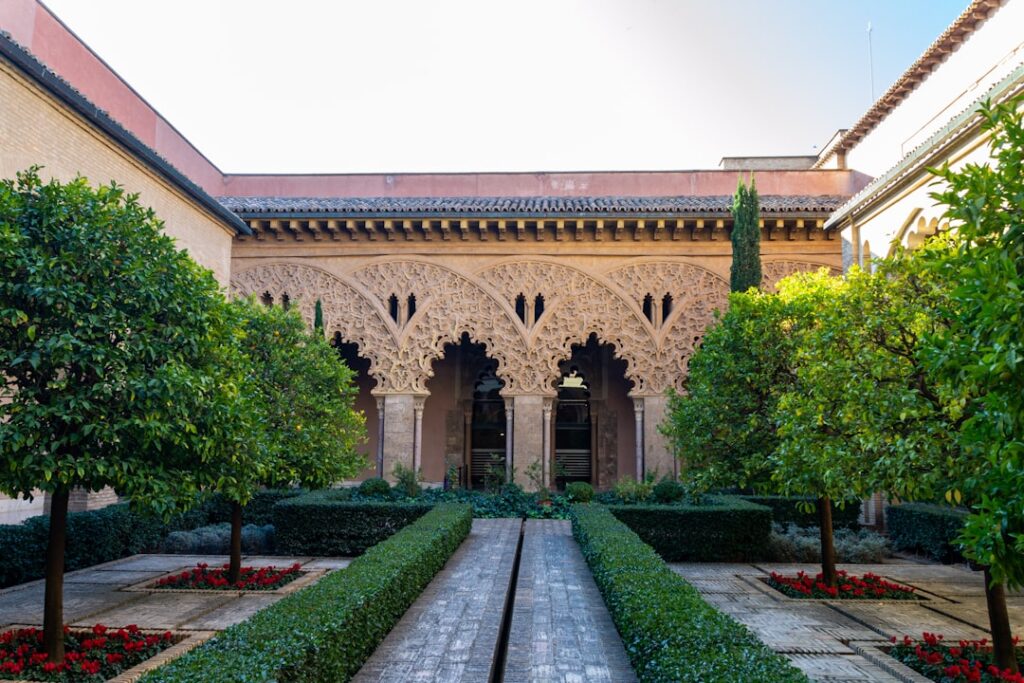
Inside the Aljafería, the first impression comes from the quiet rather than the arches. Stepping in from one of Zaragoza’s busiest roads, past the defensive walls, the city noise abruptly fades into a courtyard where orange trees and intricate plasterwork suggest an entirely different atmosphere. It’s a surprising space that seems more suited to Córdoba or Seville, and it’s a must-see in Zaragoza, especially if you appreciate history with character and enjoy discovering places untouched by crowds.
Why does the Aljafería feel so different from the rest of Zaragoza?
Because it is different. The palace began life in the 11th century as an Islamic pleasure palace for the taifa rulers of Zaragoza, and that origin still shapes the experience of visiting it. The horseshoe arches, the intricate stucco decoration, the sense of inward-looking calm: these are not details later added for colour but the core of the place.
What makes the building so memorable is that it never froze in one historic moment. After the Muslim period it became a palace of the Catholic Monarchs, later a fortress, then a prison and a military barracks. Since 1987 it has housed the Cortes de Aragón, the regional parliament. That should, in theory, make it feel over-restored or overly institutional. In practice, it gives the palace a strange and rather moving continuity. This is not a dead monument. It has been repurposed repeatedly for nearly a thousand years.
One unexpected detail to look for is the contrast between the delicacy of the Islamic decoration and the more severe later military interventions. You can almost read the political history of Aragón in stone and plaster, from courtly refinement to defence and control. Many first-time visitors expect a single coherent style and are briefly wrong-footed by that mixture. That is exactly why the Aljafería lingers in the mind longer than many more famous Spanish monuments.
If you have only one major sight in Zaragoza, make it this one. The Basilica del Pilar may dominate postcards, but the Aljafería tells a deeper, messier and more revealing story about the city.
How much time do you really need, and when should you go in summer 2026?
More than most people allow. If you rush, you can walk through in under an hour, admire the courtyard, glance at the throne room, tick the box and leave. If you actually want to understand what you are seeing, allow at least 90 minutes and ideally two hours. The palace rewards slow looking.
In summer 2026, from April to October, the opening hours are 10:00 to 14:00 and 16:30 to 20:00, every day. Guided visits run at 10:30, 11:30, 12:30, 16:30, 17:30 and 18:30. That late-afternoon reopening is useful in July and August, when Zaragoza’s heat can be blunt and unromantic. If you are planning your day sensibly, lunch and a siesta-like pause in the centre followed by a 17:30 or 18:30 visit works far better than trudging out there at the hottest point of the day.
The small scheduling detail many people miss is that the palace closes between the morning and afternoon sessions, so do not turn up at 15:00 assuming you can wait inside. Also note the annual closures on 25 December and 1 January, irrelevant for summer but worth knowing if you are planning a return trip.
For summer atmosphere, I would choose one of the first morning guided visits or the final one of the day. Early light gives the stone a softer colour; later in the evening the exterior walls and moat area feel less exposed. The guided tours are particularly worthwhile here because the palace’s layers are not always self-explanatory. This is one of those monuments where context genuinely changes what you see.
What does a visit cost, and is there a clever way to save money?
Yes, and the prices are refreshingly modest by Spanish major-monument standards. In 2026, the general ticket is 7 euros. The reduced ticket is 2 euros for pensioners and students. Children under 12 go free. There is also free entry on the first Sunday and Monday of each month.
That free-entry detail is valuable if you are building a budget-conscious Zaragoza city break, though it comes with an obvious trade-off: those dates can be busier. If your main goal is atmosphere rather than savings, I would still pay the 7 euros and choose a quieter slot. Seven euros for one of Spain’s most important surviving Islamic palaces is, frankly, a bargain.
There is another practical angle here. Because the Aljafería is both architecturally significant and logistically easy to reach from the centre, it works well on a shorter trip when you do not want to gamble on half-day excursions. British visitors often underestimate Zaragoza because they compare it, unfairly, with Barcelona, Madrid or Seville. The better comparison is with a compact, rewarding weekend city where your sightseeing time goes further. The Aljafería is central to that equation: a major monument without the time-drain and wallet-drain of larger tourist hubs.
Can you walk there easily from the centre, or is it awkward?
It is easier than it looks on a map. From Plaza del Pilar, the walk is roughly 1.5 km, around 20 minutes on foot. From Zaragoza-Delicias station, it is about 2 km, roughly 25 minutes walking. That makes the palace unusually convenient both for people staying in the historic centre and for anyone arriving by train and wanting to start sightseeing almost immediately.
The route from the old centre is not the prettiest walk in Zaragoza, and that is worth saying plainly. You are not drifting through endlessly atmospheric medieval lanes all the way there. Part of the approach is defined by broad roads and traffic. But the upside is that the change in setting sharpens the arrival. The palace’s fortified bulk appears almost abruptly, and that slightly stark urban context makes it feel more improbable.
If you like joining sights together on foot, a good sequence is to start around Plaza del Pilar, cross the centre after breakfast, visit the Aljafería in the morning, then wander back for lunch in El Tubo. That rhythm works especially well in summer before the afternoon heat settles in. If you are arriving from Delicias, the palace can also function as your first stop before checking in, which is one reason it makes such a smart anchor for a weekend break.
What should you notice inside that most visitors walk straight past?
The obvious stars are the Islamic arches and the famous courtyard, and yes, they deserve the attention. But there are subtler details that tell you more about the building’s strange life. One is the tension between openness and defence. The palace began as a place of pleasure and display, yet over centuries it became increasingly fortified. That shift is visible not just in grand structural changes but in the mood of different spaces.
Another thing to notice is how the Catholic Monarchs did not simply erase what had come before. Their additions changed the palace profoundly, but the result is layered rather than blankly replacement-driven. The building becomes more interesting the moment you stop asking, “Which bit is original?” and start asking, “What does each period reveal about the people who needed this place?”
If you can, pause longer than usual in transitions: corridors, thresholds, stairways, places where one political era gives way to another. Visitors often photograph the most ornate rooms and speed through the connective tissue, but that connective tissue is where the Aljafería’s biography really sits.
One more curiosity for 2026: the palace is also a useful place from which to think about Aragón’s wider cultural calendar. The bicentennial commemorations related to Francisco de Goya begin in 2026 across Zaragoza and beyond, and the palace’s role in special programming makes it more than a static historical stop. It is part of the city’s living cultural conversation.
What is actually happening at the Aljafería in 2026 beyond the standard visit?
Two 2026 events make the palace especially interesting if your dates line up. The first is the Noche en Blanco on 27 June 2026, when from 22:00 to 00:00 there will be a special visit to the Aljafería and the exhibition “Goya: del museo al palacio”. That late-night format suits the building beautifully. Zaragoza in June can be intensely hot during the day, and seeing the palace in evening hours offers a completely different texture: softer light, cooler air and a more ceremonial mood.
The second is the XXV Jorgeada de Aragón, held on 22 and 23 April 2026. This is the 25th edition of the long-distance walk from the palace to the hill of San Jorge in Huesca, around 80 km, marking Saint George, patron of Aragón. Even if you have no intention of walking it, the event says something revealing about the Aljafería’s place in local life. It is not merely a backdrop for tourists; it is a symbolic civic starting point.
For travellers who like to tie a city break to a particular event, these dates matter. Zaragoza tends to feel more local than performative during cultural occasions, and that is one of its strengths. You are less likely to feel herded through a spectacle designed entirely for outsiders.
Where should you eat after visiting, without falling into the obvious tourist trap?
Near the palace and back towards the centre, there are a few reliable names worth knowing. Restaurante El Fuelle is a good choice if you want traditional Aragonese cooking done with confidence rather than nostalgia for its own sake. It is the kind of place to order something substantial and local after a morning of sightseeing.
Bar Cervino is a useful stop if what you want is a more casual tapas break and the sort of lively, unfussy atmosphere that makes Zaragoza easy to like. It is the kind of bar where an intended quick drink has a habit of becoming another round and a couple more plates.
For coffee, tea or a slower pause, Café Botánico is a pleasant option, with homemade pastries and a calmer feel than the busier central bars. That can be very welcome in summer when you need an hour indoors before heading back out.
If you continue into the old centre afterwards, you can of course eat in El Tubo, but choose specifically rather than wandering until hunger wins. Zaragoza is full of bars that are fine, and a smaller number that are memorable. The city rewards precision.
Is the Aljafería a smart base for a Zaragoza city break, or just a single sight?
It is both, and this is where Zaragoza often surprises British travellers. The city is compact enough that where you sleep can shape the whole tone of the trip. Base yourself centrally and the Aljafería becomes not an expedition but an easy walk, one part of a wider weekend that also includes the Roman remains, the cathedral area, tapas stops and long evening strolls along broad streets that never feel overrun.
Is Zaragoza worth visiting? Honestly, yes, especially if you are tired of places that spend all day performing their own fame. It does not offer the instant wow-factor overload of Spain’s biggest-name cities. What it offers instead is proportion: serious monuments, excellent food, sensible prices, easy walking and a lived-in atmosphere. The Aljafería is the best example of that balance. It is major-league heritage in a city that still behaves like a real place.
For where to stay, one genuinely practical option is ZaragozaHome, with two apartments at Puerta Cinegia between El Tubo and Plaza España. The location is hard to beat for a short stay, private parking is included, Booking.com scores it at 9.8, and rates start from €85 a night. For a weekend focused on walking, eating well and fitting in a palace visit without complicated transport, that central setup makes a lot of sense.
FAQ
How long does it take to visit Aljaferia Palace Zaragoza?
Allow 90 minutes to 2 hours if you want to do it properly. You can pass through faster, but this is a palace where the historical layers matter, so a guided visit is worth considering.
Is Aljaferia Palace Zaragoza free on any day?
Yes. Entry is free on the first Sunday and Monday of each month. Otherwise the general ticket is 7 euros, reduced entry is 2 euros for pensioners and students, and children under 12 enter free.
Can you walk from Plaza del Pilar to the Aljafería?
Yes, easily. The distance is about 1.5 km and takes around 20 minutes on foot. From Zaragoza-Delicias station it is about 2 km, or roughly 25 minutes walking.
Stay central and make the Aljafería an easy walk
If you want a practical base for a Zaragoza city break, these Puerta Cinegia apartments sit between El Tubo and Plaza España, with private parking included, a 9.8 Booking.com score and rates from €85 per night.
Looking for accommodation in central Zaragoza? Our ZaragozaHome apartments are steps from the Pilar, La Seo and El Tubo. Private parking included and rated 9.8 on Booking.com.